

In the late summer, I make seedless raspberry jam. It’s part of my calendar of the harvest, coming right after peach-oolong jam and before apple butter.
I like to have the seedless version of raspberry jam in my pantry, even though it’s harder to make. It’s useful in a lot of applications (cakes, frostings, sauces) and I’d prefer to have jars ready.
While I can use my handy Kitchen Aid to squish tomatoes, the strainer attachment has no tiny screen that would help me with berries. So I turn to old-fashioned methods: a fine-mesh sieve, a big spoon, and elbow grease. I won’t kid you: it takes a lot of effort, but there’s a great payoff for your trouble.
I tend to use my favorite pot for this batch, though anything you have that’s wider than it is tall, and which is heavy enough that the bottom won’t scorch, will do just fine.
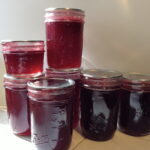
Seedless Raspberry Jam
Ingredients
- 2 quarts fresh raspberries (about 2½ pounds in all)
- 6-7 cups granulated sugar
- 2-3 tbsp fresh lemon juice
- ½ tsp unsalted butter (optional)
Instructions
- Heat oven to 225˚F. Rinse the raspberries and drain them well. Put them into a heat-proof dish. I found that my 2 quarts fit nicely in a 13×9 Pyrex pan. Bake the pan of berries, uncovered, for about 30 minutes, because heating the berries gently will make it easier to sieve the seeds out.
- Put a fine-mesh sieve over a large bowl or pot. Take the pan of hot raspberries out of the oven and sieve the berries in batches. Scoop some of the softened berries into the sieve, and press the pulp and juice through with a big spoon. It’s surprisingly hard work to press the berries through the sieve. You want to end up with only seeds in the sieve, as dry as you can manage. When you’ve pressed out as much fruit as you can, put the seeds in a clean quart-sized jar (* see Notes) and set aside. Repeat until all the berries have been sieved. Don’t forget to scrape the underside of the sieve with a clean spoon, to get all the pulp off it!
- Combine the raspberry pulp with three-quarters its weight in sugar, or just estimate by volume, adding 6 c sugar to the lot, tasting it, and adding a bit more if it’s too tart. Add lemon juice. Heat at a very low setting, and stir until sugar is dissolved. Taste again for balance of sweet and tart; adjust as you wish.
- Now add the pat of butter (it helps reduce foaming) and turn heat to high. Bring the jam to a boil, stirring frequently, until the jam thickens and will pass a wrinkle test. Ladle jam into prepared jars, wipe rims, and apply lids and bands. If your last jar is only partly filled, just stick a lid on it and refrigerate.
- Ladle jam into prepared jars, wipe rims, and apply lids and bands. Refrigerate any partially filled jar, and seal the rest in a boiling water bath for 10 minutes.
7 Comments
Hi – Thanks for posting this. I froze some raspberries and strawberries this past summer and am starting to make some jam for Christmas gifts. I am also going to make the raspberry vinegar.
I started with two pounds of raspberries and once I strained them, I ended up with about two cups of juice. Does that seem about right? I imagine I will use less sugar than if I had started with 2 1/2 lbs? Also, should I start with 2 Tbls of lemon juice or maybe only about 4 1/2-5 teas? Thanks again.
The best thing to do is to weigh the pulp/juice – then you’d use 3/4 the weight in sugar – example, 1 pound pulp, 3/4 pound sugar. If you don’t have a scale, measure the pulp/juice by volume, and use up to 3/4 the volume in sugar – example again, 1 quart pulp, 3 cups sugar.
2 cups of pulp/juice is much much less than I had, after roasting and then straining. I pressed the pulp through a fine sieve with a big spoon, to try to get as much as possible off the little seeds. If you have only 2 cups of pulp/juice, then use only 1 to 1.5 cups sugar. And yes, I’d start off with much less lemon juice, too.
Thanks for the help.! My strainer has really, really fine mesh (almost like silkscreen mesh). The next size up was too course so after I pressed the berries through the strainer, I put the pulp in some cheesecloth and squeezed as much juice through that as I could. I then put the pulp in a quart jar with white vinegar, as you suggest.
Well, I got just over a pint of jam – guess I need to re-think the whole seedless thing
Wondering about the raspberry vinegar. Is it safe to leave in a cool dark place or should I put it in the fridge. Once it’s strained, is it shelf stable or should it be kept in the fridge? Thanks.
Yes, the raspberry vinegar keeps at room temperature for up to a year. It’s best kept in the dark – if it’s stored in too much light, the color and flavor will fade.
Do you use pectin at all? I’m new at all this lovely canning stuff and just don’t know the difference between using and not using it. Thanks for your help!
I rarely use added pectin. Raspberries tend to have enough on their own, and the lemon juice added for flavor and proper acidity helps there too. I do use pectin in my peach-oolong jelly. I will always list it clearly if I add pectin in a preserve.